 Priya Patel
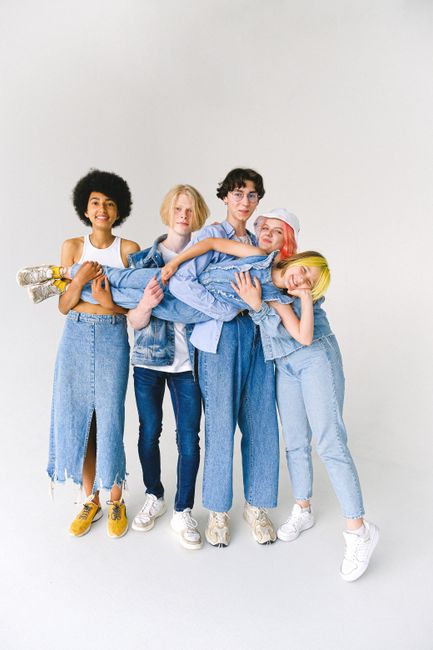
For petite frames, balance has less to do with adding height than with spreading visual weight well. A top-heavy, bottom-heavy or overwhelmed look usually points to proportion rather than to the body itself. Adjusting waist positions, hem lengths and detail sizes can turn a wardrobe into something that feels considered. Thinking in blocks of colour and fabric, and in the lines that cross them, gives you a practical starting point. It is a topic closely linked to jackets, which comes up more than once below.
Define the waist and select hems with purpose
In most outfits, the strongest horizontal point is the waist. A waist placed at its natural level, or just above, creates a clear midpoint for the eye and prevents tops from engulfing the hips. Particularly when the rise rests flat rather than bunching, high-rise trousers and skirts carry this off without fuss.
The same importance applies to hemlines. A skirt ending at the slimmest part of your leg, regularly just above or below the knee, generally appears more thoughtful than one finishing midway down the calf. For trousers, a clean break at the ankle or a cropped length that shows a little ankle keeps the lower half from looking heavy. Where a long hem is wanted, pick a straight or gently tapered line instead of a wide shape that pools.
With layering, the same reasoning holds. The waist stays visible with a cropped jacket or short cardigan ending at the high hip, whereas a long unstructured layer can obscure it completely. Should longer layers be your preference, select a narrow-bodied one and leave it unfastened to keep the vertical line clear.
Add vertical lines without looking stiff
Vertical lines take the eye vertically, helping an outfit read as taller and more cohesive. A slim column of colour, like a jumper and trousers in similar shades, achieves it with no effort. A straight cardigan or an open shirt, as a long open layer, likewise gives two neat vertical edges. Many readers also find custom jackets shop helpful here.
What matters is that the lines stay narrow and purposeful. While a boxy jacket left open can broaden the look, a jacket with a closer body fit preserves a tidy line. Opt for lapels, plackets and scarves lying close to the body, not ones that flare out. Vertical lines need not look severe, since a soft knit dress or straight-leg trousers in one colour can be relaxed and still work.
Think in thirds, not halves, for the body
One common cause of a petite outfit looking off is a waistline that halves the body. Instead, use thirds: a mid-layer that ends at the high hip, a top that stops around the hip bone, and a bottom that extends to the ankle. A staircase of lengths, not a single horizontal block, is the result.
Colour offers another way to use this principle. Keep the eye moving with a dark base layer, a lighter mid-layer and a third tone at the shoe. For a simpler palette, keep the colours near each other and let lengths carry the work.
- See where the end of your top falls in relation to the waistband.
- See whether your jacket stops at the hip's fullest area.
- Check the way your trousers fall over your shoes.
- Work out if your bag sits at hip height or above it.
- Check if your sleeves stop at a clean spot on your wrist.
- Stand back and check whether the visual weight is concentrated in one area.
The idea of thirds is a guide rather than a rule. A dress or a jumpsuit, as a single long line, can suit some outfits best and be just as balanced. What matters is avoiding unintended halves that leave the outfit looking chopped.
Select detail sizes to fit your frame
While tiny details can look mean, sizeable-scale ones can overpower a petite frame. More easily read are a medium bag carried under the arm, a collar staying within the shoulder line, and jewellery in keeping with your natural proportions. The same applies to prints: an oversized one may dominate, while a small dense one can seem busy. A moderate print scale with a little negative space tends to give the best balance.
Think as well about how deep your necklines are and how long your sleeves sit. While sleeves bunching at the hand create clutter, those ending at the wrist bone or just above appear neat. Without broadening the shoulders, a neckline that opens the chest, like a V or soft scoop, allows the face room.
It is easy to misjudge scale when choosing necklaces and scarves. Against a heavy knit a delicate chain may vanish, while a chunky scarf can create bulk near the face. Keep the rest quiet and pick a single focal point close to the face.
Try minor tailoring changes with impact
Shoulders and sleeves
Shoulder seams placed beyond the natural shoulder make a petite frame seem dressed in someone else's jacket. Shortening the sleeve or taking in the shoulder can be done by a tailor at modest expense. A coat or blazer will immediately seem more intentional if its sleeves finish at the wrist bone rather than midway down the hand.
Waistbands and hem lengths
Among the most effective adjustments is shortening a hem. Trousers that pool at the shoe can make you seem shorter; a clean break at the ankle avoids this. Especially on skirts, waistbands can be moved or taken in so that the waist falls where your body naturally bends.
Footwear and leg line
The leg line is extended quietly by shoes matching the tone of trousers or tights. Helpful though a slight heel or pointed toe can be, shape is more vital than height. For the leg to appear as one continuous line, shoes with heavy ankle straps should be avoided.
Balance means consideration
These adjustments call for no new wardrobe, only attention to hems, waists, detail scale and line. With a little tailoring and a clearer eye for proportion, an outfit can feel considered rather than accidental. The reward is not a different height or frame, but a clearer version of yourself and a faster, calmer way to get dressed. The same thinking applies well to jackets.


